


Messages
BOTTRRIER
I spent time with Messages as a straightforward communication app, and my first impression was that it is trying to solve a familiar problem: making everyday SMS conversations easier to manage without turning the experience into a social network or a feature-heavy chat platform. It is free, aimed at everyone, and developed by BOTTRRIER. That combination makes it easy to consider if you want a simple messaging option rather than another account-based service.
The important thing to understand is its role. This is a preset SMS messaging application, so I would look at it primarily as a practical tool for sending and organizing ordinary text messages. It is not the same kind of service as an internet messenger built around calls, channels, stickers, large media libraries, or group communities. If your communication needs are mostly short messages to people who already use phone numbers, its focus makes sense. If you expect a complete replacement for every modern chat service, the narrower purpose may feel limiting.
How Messages feels in everyday use
In normal use, the appeal is the reduced distance between opening the app and handling a text conversation. A preset SMS app should feel familiar quickly, and that matters when you are replying while commuting, checking a delivery update, or answering a family message between other tasks. I found the concept more useful when I treated it as a dependable front door for SMS rather than expecting it to behave like a universal inbox.
The current version is 1.1.0, and the app has already reached over one hundred thousand installs. Its average rating is 4.5 from roughly three hundred ratings, which suggests that the basic idea is working well for a noticeable group of users. I would not treat that rating as a guarantee for every phone, but it does make Messages worth trying when you want a free alternative in the communication category.
One of the more practical questions is whether it can replace the messaging app you already use. The answer depends on what you value. For ordinary SMS, a dedicated application can be less distracting than a large communication suite. You are not choosing it for a huge contact ecosystem or a stream of online content; you are choosing it for the act of handling messages. That narrower purpose can be a strength for people who want fewer layers between a notification and a reply.
Related News

Why WhatsApp Messenger Still Makes Everyday Communication Feel Easy

Jurassic World: The Game Is the Better Dino Tycoon for Strategic Players

Threads in Real Life: Who Should Join, Lurk, or Leave

How SHEIN Turned Shopping Into an Endless Content Feed

How to Make Fortnite Feel Smarter on Mobile

Should You Switch to Microsoft Outlook on Mobile?
Where the speed impression matters
I pay attention to how quickly a messaging app lets me understand what needs attention. With an SMS-focused tool, perceived speed is not only about opening time. It is also about whether the conversation view feels direct, whether the latest message is easy to find, and whether composing a reply feels like a separate task from browsing a complicated service. Messages benefits from being judged on that kind of everyday efficiency.
There are also limits to what any SMS application can control. The application can present a conversation clearly, but the actual delivery experience can depend on the mobile network and the recipient’s phone service. A message that seems slow is not automatically evidence that the app is slow. I would separate the two before deciding that Messages is at fault.
My useful tip is to test the app during the situations in which you genuinely send texts, not only during a quiet setup session. Send a short message, receive a reply, open an older conversation, and switch away before returning. That small routine tells you more about whether the app fits your habits than simply reading the feature summary. It also helps you notice whether your phone is comfortable with it as a daily default.
Gallery
What happens during heavier messaging days
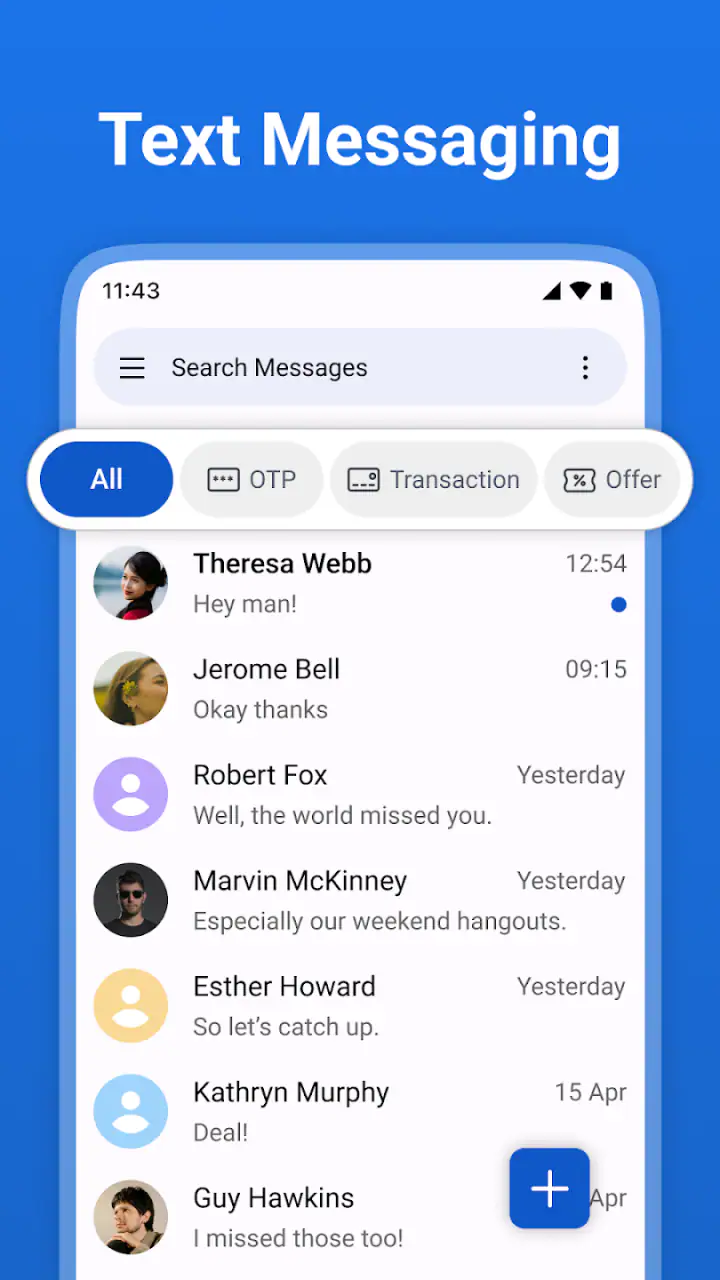
Light use is easy to imagine: a few personal conversations, appointment reminders, and occasional replies. The more revealing test is a busy day when several conversations arrive close together. That is when organization matters more than the novelty of the app. I would look for whether the newest exchanges remain obvious and whether switching between conversations still feels natural instead of becoming a search exercise.
Messages is most attractive to people whose “heavy use” means many ordinary SMS threads rather than large media-heavy group chats. That distinction is important. An SMS application can be a sensible choice for coordinating a family pickup, responding to work alerts, or handling one-time codes and service messages. It is less compelling if your day is dominated by internet calls, image sharing, voice notes, or large communities that live outside traditional texting.
A realistic example is a day of travel. I might use it to answer a hotel’s text, coordinate a meeting point with a friend, and respond to a family member who does not use the same internet chat service as I do. In that situation, the value is not entertainment or collaboration; it is having one focused place for phone-number conversations. I would still keep expectations practical, because the app does not turn SMS into a full internet-based collaboration platform.
Another non-obvious trade-off is that a focused SMS workflow can reduce mental clutter while also making the app feel less versatile. When I want to send a quick text, that focus is helpful. When I want richer interaction, I would rather use a service designed around that purpose. Choosing Messages therefore means accepting a boundary: its usefulness rises when the task is clearly SMS, and falls when the task starts requiring tools from a broader messenger.
Reliability and recovering from interruptions
For a communication app, reliability is not just whether it opens. I also care about what happens after an interruption: a phone call, a weak signal, a quick switch to another application, or an accidental exit while writing. I would judge Messages by whether it lets me return to the same conversation without unnecessary confusion. That recovery experience is especially important for short messages because people often write them in spare moments rather than in one uninterrupted session.
I would also avoid blaming the application for every failed delivery. SMS depends heavily on the carrier connection, and a recipient may be unreachable for reasons outside the app. The sensible approach is to check whether the issue affects one message or the whole phone connection, then try again when the network is stable. Messages can serve as the interface for the task, but it cannot remove the conditions imposed by mobile service.
There is a useful habit here: before relying on any new SMS app for important communication, I would test both sending and receiving with someone I trust. I would then close and reopen the conversation, return after another task, and confirm that the exchange remains easy to follow. This is not a claim about a hidden feature; it is a practical setup check that can prevent surprises when the message matters.
The app’s broad age rating also makes its purpose easy to understand. It is suitable for everyone, which fits a basic communication tool that can be used across a household. Still, an age rating does not explain every personal preference. Parents, older relatives, or users who need accessibility options should try the interface on the actual device they plan to use, since comfort with text size, navigation, and notifications can vary from person to person.
Resource demands and device constraints
I would expect a focused SMS application to be less demanding than a communication service built around constant media feeds or live video, but I would not invent a battery, memory, or data figure for it. The honest way to assess resource use is to observe your own phone over a normal day. Pay attention to whether Messages remains comfortable alongside the apps you already depend on, especially on an older device with limited free storage or memory.
Device age can change the experience more than people expect. A newer phone may make almost any messaging application feel immediate, while an older phone can reveal delays caused by the operating system, background activity, or general storage pressure. If Messages feels sluggish, I would first restart the device, clear unnecessary clutter, and compare the behavior with another ordinary app. That does not excuse poor performance, but it avoids drawing a conclusion from a phone-wide problem.
Users with limited mobile data should also keep the app’s role in mind. Traditional SMS is different from an internet messenger, and that difference is part of the reason someone might choose this kind of application. However, the surrounding phone environment still matters: notifications, backups, system updates, and other applications can affect data use. Messages is a better fit for someone who wants text communication to remain simple than for someone looking for a media-rich service with every conversation feature in one place.
One practical workflow is to keep the app for SMS while using a separate service for richer conversations. That arrangement avoids forcing one tool to handle incompatible jobs. I might use Messages for contacts who communicate by phone number and another messenger for people with whom I share files, images, or calls. The trade-off is having two places to check, but the benefit is that each app can stay focused on what it does best.
How it compares with usual alternatives
The most obvious alternative is the messaging application already installed on the phone. That option has the advantage of familiarity and usually requires no change in habit. Switching to Messages only makes sense if its handling of SMS feels clearer or more comfortable to you. I would not change simply because a separate app exists; I would change after noticing a real improvement in the way I read, compose, and return to conversations.
Internet messengers are a different comparison. They can offer richer media, calls, reactions, group tools, and cross-device experiences, but they often require the recipient to use the same service and maintain an internet connection. Messages is more appropriate when the phone number is the important connection. That makes it particularly useful for practical contacts, people who avoid extra accounts, or situations where ordinary texting is still the shared language.
There is also a privacy and simplicity trade-off that I would consider personally rather than presenting as a universal promise. A focused SMS tool may feel less socially demanding because it is not built around a large online identity or community. At the same time, I would not assume that a simple interface automatically provides every privacy control found in a specialized secure messenger. If sensitive communication is your main concern, compare the controls and habits you need before making Messages your default.
The developer, BOTTRRIER, has positioned this release as a practical communication application rather than a broad social platform. That helps explain why I see the app as a utility choice. It is not competing on the same terms as services centered on video, communities, or elaborate media sharing. Its strongest argument is that a user may want a dedicated place for SMS without adding the complexity of a larger communication ecosystem.
Who should use it, and who should skip it
I would recommend trying Messages if you send regular SMS, want a free application, and prefer a focused conversation tool. It also makes sense for someone setting up a phone for a relative who mainly exchanges ordinary texts. The Everyone rating supports that broad audience, while the strong average rating and growing install base make it a reasonable candidate for a trial rather than an obscure experiment.
I would be more cautious if your communication is mostly group-based, media-heavy, or dependent on internet calling. In those cases, a mature internet messenger is probably the better primary choice. I would also skip switching if the phone’s built-in messaging app already gives you everything you need and you have no specific frustration to solve. Installing another app without a clear reason can create duplicate notifications and make it harder to remember which conversation belongs where.
People who need a single inbox for several communication services may also find the focused design restrictive. Messages is not the app I would choose to unify email, social messages, work chats, and SMS. Its value comes from not trying to be all of those things. That is a strength for users who want separation, but a weakness for anyone who measures convenience by having every channel in one screen.
My performance verdict after living with the idea
My overall view is favorable, with a clear condition: Messages works best when you want SMS to stay SMS. The free price removes the main barrier to testing it, and the current 1.1.0 release gives users a straightforward starting point. Its communication focus, broad age rating, and established rating activity make it easy to recommend as an option for everyday texting, especially when the default app on a phone does not suit you.
I would describe its perceived performance as potentially strongest in short, focused interactions rather than demanding communication sessions. Opening a conversation, checking a reply, and sending a quick answer are the tasks that match its identity. For reliability, I would judge the app together with the phone and carrier rather than treating every delivery delay as an application problem. For resource use, I would verify the experience on the device I intend to keep using, particularly if it is older or already crowded with apps.
The most important decision is not whether Messages has “many powerful functions” in the abstract. It is whether those functions make your particular SMS routine easier. Test it with real conversations, check how it behaves after interruptions, and compare it directly with the app you already use. The right reason to install it is a clearer SMS routine, not the hope that it will replace every kind of messenger.
After that test, my recommendation is simple. Keep Messages if it makes ordinary texting feel faster to understand and easier to return to. Move to a richer internet messenger when your needs center on calls, media, or communities. For users who want a free, focused communication app for phone-number messaging, this release from BOTTRRIER is a sensible option to consider, provided its focused scope matches the way they actually communicate.
FAQs for Messages
What are the primary features of the Messages app?
The Messages app offers a robust platform for sending texts, photos, videos, and audio messages. It also supports group chats, emojis, and stickers, enhancing communication. With end-to-end encryption, your privacy is safeguarded, ensuring secure conversations. Additionally, the app includes features like message search, customizable notifications, and integration with other apps.
Is Messages available on both Android and iOS?
Yes, the Messages app is available on both Android and iOS platforms. However, the features may vary slightly between the two. For instance, iOS users benefit from iMessage, which offers additional functionalities like message effects and reactions, while Android users can enjoy RCS (Rich Communication Services) for enhanced messaging.
Does the Messages app use data or Wi-Fi for sending messages?
Messages can send texts via your mobile network as standard SMS/MMS or use Wi-Fi/data for enhanced messaging features like iMessage or RCS. If connected to Wi-Fi, it prioritizes using it to save on data costs, especially when sending media files or participating in group chats.
How does the Messages app handle privacy and security?
Privacy and security are top priorities for the Messages app. It employs end-to-end encryption for secure communication, ensuring only you and the recipient can read your messages. Additionally, the app provides options to manage who can contact you, block unwanted numbers, and report spam messages.
Can I customize my experience on the Messages app?
Absolutely! The Messages app allows users to personalize their experience with customizable notifications, themes, and chat backgrounds. You can also organize conversations through pinned chats or labels. For iOS users, iMessage offers added customization like Animoji, Memoji, and message effects for a more interactive experience.
Pros
- User-friendly interface makes texting easy.
- Supports multimedia messages seamlessly.
- Offers end-to-end encryption for privacy.
- Syncs across devices for convenience.
- Customizable notifications and themes.
Cons
- Limited customization for message bubbles.
- Lacks advanced search functionality.
- No built-in translation for texts.
- Group chat features are basic.
- Cannot schedule messages to send later.


